
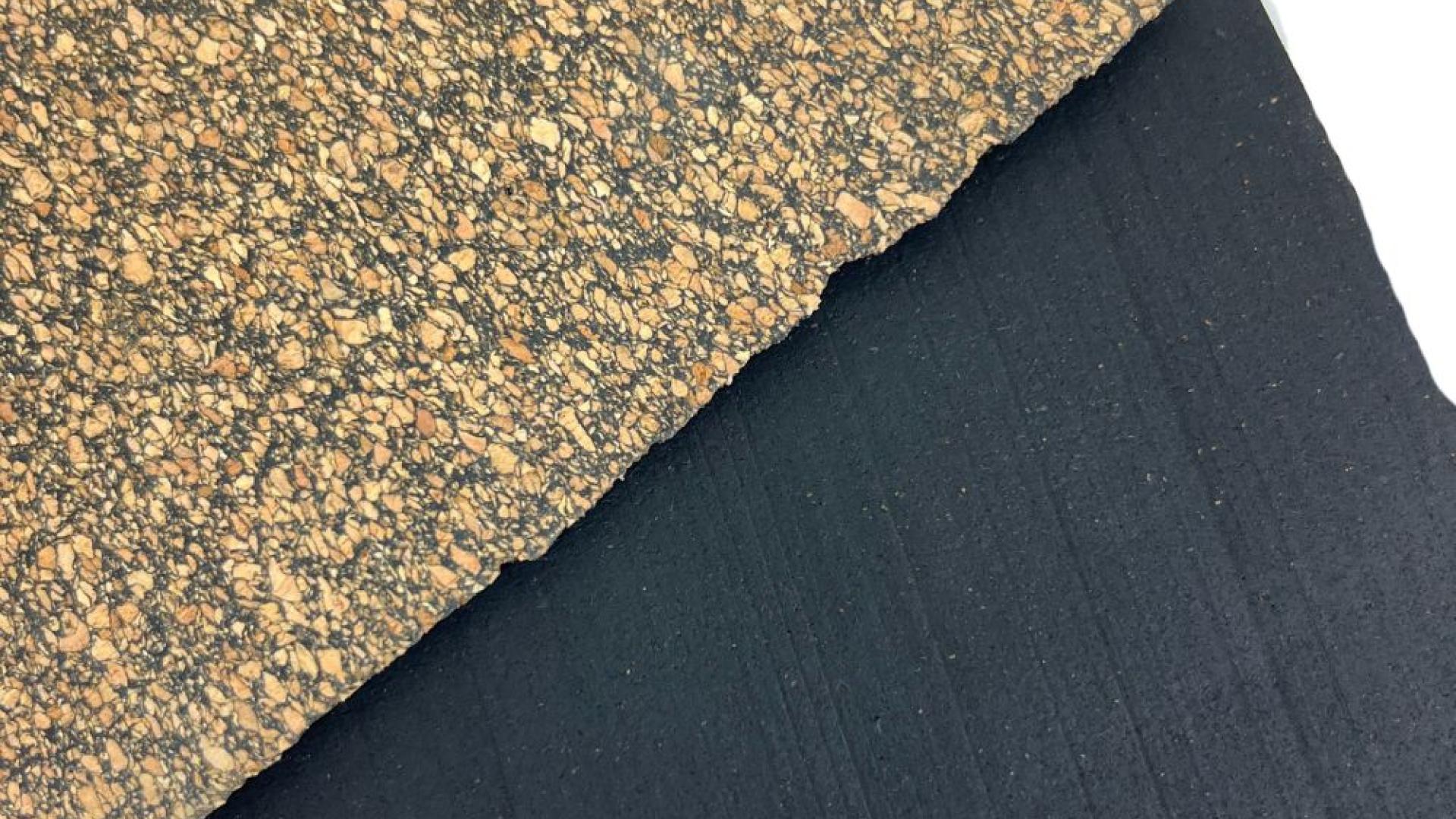
What is Rubber Cork?
Rubber cork is a composite material made by combining natural cork granules with rubber, often bound with polyurethane.
This mixture is valued for its versatility and excellent physical properties, making it suitable for a wide range of industrial applications, particularly in the seal and insulation sectors.
Thanks to the production process, rubber cork retains the ecological characteristics of cork, combining environmental sustainability with enhanced performance due to the presence of rubber.
Why choose Rubber Cork?
The main characteristics of rubber cork include:
Acid and Weather Resistance

Due to the presence of rubber, the material is highly resistant to harsh environmental conditions, such as exposure to weather, acids, and other chemical agents.
Insulating Properties
Rubber cork is an excellent thermal and acoustic insulator. Its ability to reduce vibrations and noise makes it ideal for applications requiring sound insulation, such as anti-vibration gaskets or industrial acoustic insulation.
Compression Resistance
One of its most appreciated features is its high resistance to compression and abrasion, making it perfect for applications where dimensional stability and long-term durability are required.
Sustainability

Since cork is a natural and renewable material, it retains an ecological profile even in composite form. This makes rubber cork a green solution for many industrial sectors.
Rubber Cork vs. Other Materials
Compared to other insulating materials like pure rubber or synthetic polymers, rubber cork offers a superior combination of flexibility and mechanical strength.
Compared to metallic materials, it is much lighter and more sustainable, with better insulating properties.
Its resistance to chemical agents and dimensional stability make it particularly suitable for environments exposed to harsh conditions.
Applications of Rubber Cork
Rubber cork has wide applications in the seal sector for industrial and mechanical equipment.
It is also used as an acoustic and thermal insulator in flooring and coverings, especially in areas requiring compensation for irregularities or isolation from vibrations.
It is widely used in the production of flat gaskets and sealing materials, with applications ranging from automotive to construction.
